
Riggs: From Three-Legged Lame to World Champion
For many competitive agility dogs, the difference between winning and losing can be measured in fractions of a second. The slightest loss of flexibility, coordination, or balance can dramatically affect performance. For Riggs, a talented Border Collie agility competitor, those small changes began appearing as intermittent lameness. At first, the signs were subtle. Occasionally he would favor a limb. Some days he appeared perfectly normal.
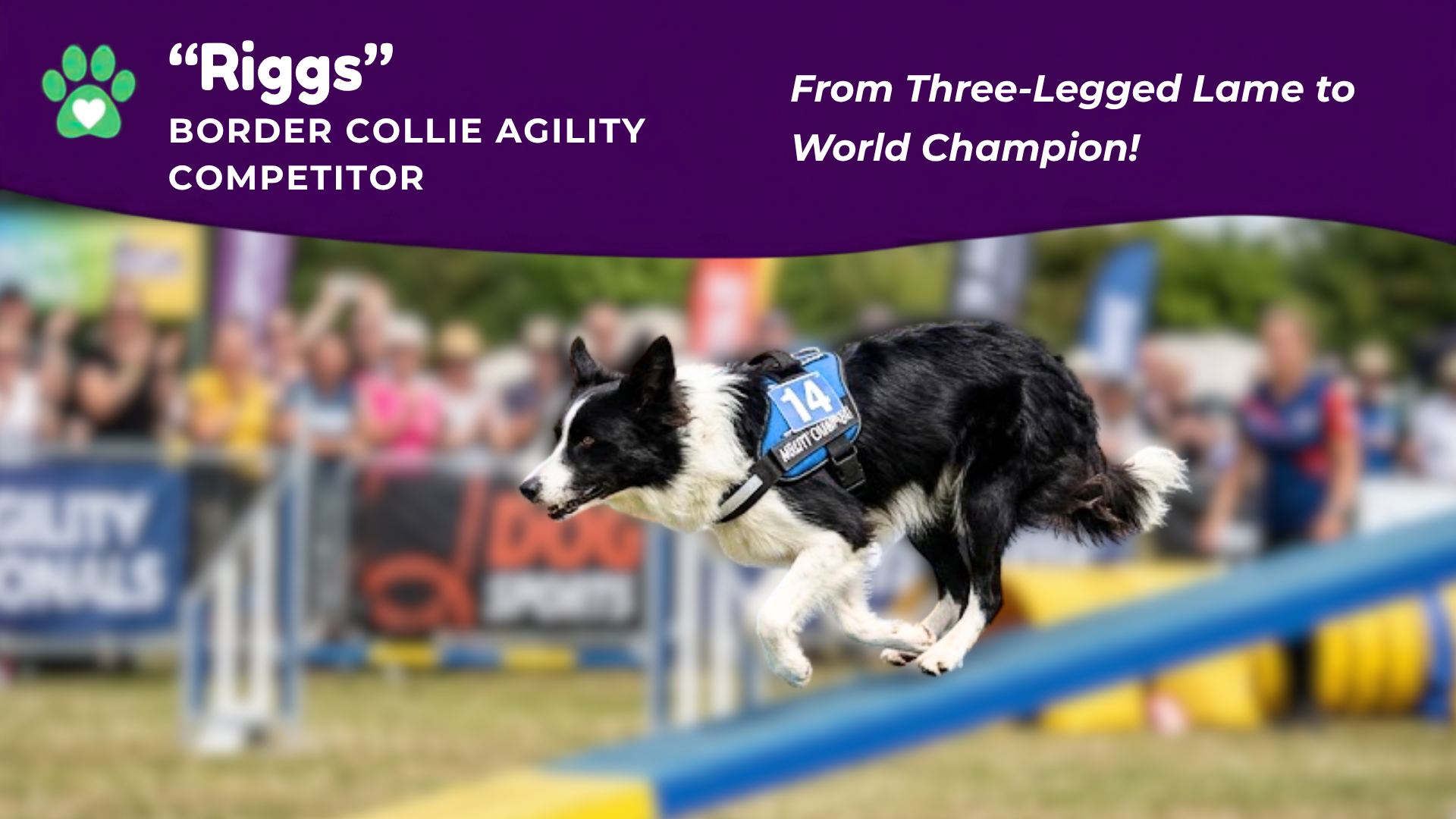
Other days, his movement was noticeably altered. Like many canine athletes, Riggs compensated remarkably well, making it difficult to determine the true source of the problem. As the condition progressed, concern grew. A positive cranial drawer sign suggested possible instability within the knee. Discussions began regarding surgical intervention and what the future might hold for Riggs’ athletic career. For owners invested in canine sports, this situation is all too familiar. A dog with extraordinary potential suddenly faces an uncertain future.
Rather than immediately moving toward surgery, a different approach was chosen. Riggs began a comprehensive rehabilitation program focused on restoring normal movement patterns, improving strength, and optimizing nervous system function. Regular chiropractic evaluations and adjustments became part of that plan. The philosophy behind this approach was straightforward.
Movement is controlled by the nervous system. If the body cannot accurately perceive its position in space, athletic performance suffers. Small biomechanical dysfunctions can alter stride length, timing, balance, and coordination long before obvious injury occurs. By restoring motion and improving communication between the brain and body, the goal was to help Riggs perform as efficiently as possible.
Over time, improvements became evident.
Riggs moved more freely. His confidence increased. Training sessions became more consistent. Most importantly, he was able to continue competing. What followed was a career that exceeded every expectation.
Riggs went on to earn numerous prestigious agility titles and championships. He competed successfully at the highest levels of the sport and became recognized as one of the elite performers in his division. His accomplishments included appearances at national events, world-level competitions, and championship tournaments. Year after year, he continued to perform with remarkable consistency. Perhaps the most valuable lesson from Riggs’ story came later.
After years of successful competition, circumstances resulted in two regularly scheduled chiropractic visits being missed prior to an important event. Nothing dramatic happened. There was no obvious injury.
Yet his performance declined.
The precision, speed, and fluidity that had become routine were not quite the same. When regular maintenance resumed, performance improved again. This observation reinforced something that experienced trainers and competitors often recognize: peak performance is not simply about avoiding injury. It is about maintaining optimal function.
The best athletes in the world do not wait until they are injured to seek care. They continually work to preserve the qualities that allow them to excel. The same principle applies to canine athletes. Riggs’ success was not the result of one adjustment, one exercise program, or one decision. It was the result of consistent attention to movement quality over time.
His story also highlights an important distinction between treating disease and supporting performance. Many dogs are capable of compensating for dysfunction. They can continue competing despite restrictions in mobility, altered biomechanics, or neurological stress. However, compensation is not the same as optimal performance. When compensation becomes the norm, efficiency declines.
For agility competitors, that can mean slower times, missed contacts, knocked bars, or inconsistent runs. By focusing on movement quality and nervous system function, Riggs was able to continue competing at an elite level while enjoying a long and successful career. Today, his story serves as a reminder that performance begins with function. Before speed, before power, before athletic achievement, there must be efficient movement.
For Riggs, chiropractic care became one component of a comprehensive strategy that helped him achieve extraordinary success.
Every champion’s journey is unique. But every champion depends on the ability to move well.
Healthy nerves. Healthy movement. Healthy animals.